ATLAS3: The Atlas Rebuilt as a Universe You Can Fly Through
The Atlas 3 turns a procedural universe of a sextillion galaxies into one continuous 3D space, now in 11 languages and soon native on iPhone, iPad and Mac
 Claudio González
Summarize with AI
Get the key points in your languageIf you have browsed the HomeDock OS App Store, you may have come across The Atlas: a whole universe generated from a single seed, with no database and nothing stored. Every galaxy, star, planet and moon is worked out by mathematics the moment you look at it, and it is always the same when you come back.
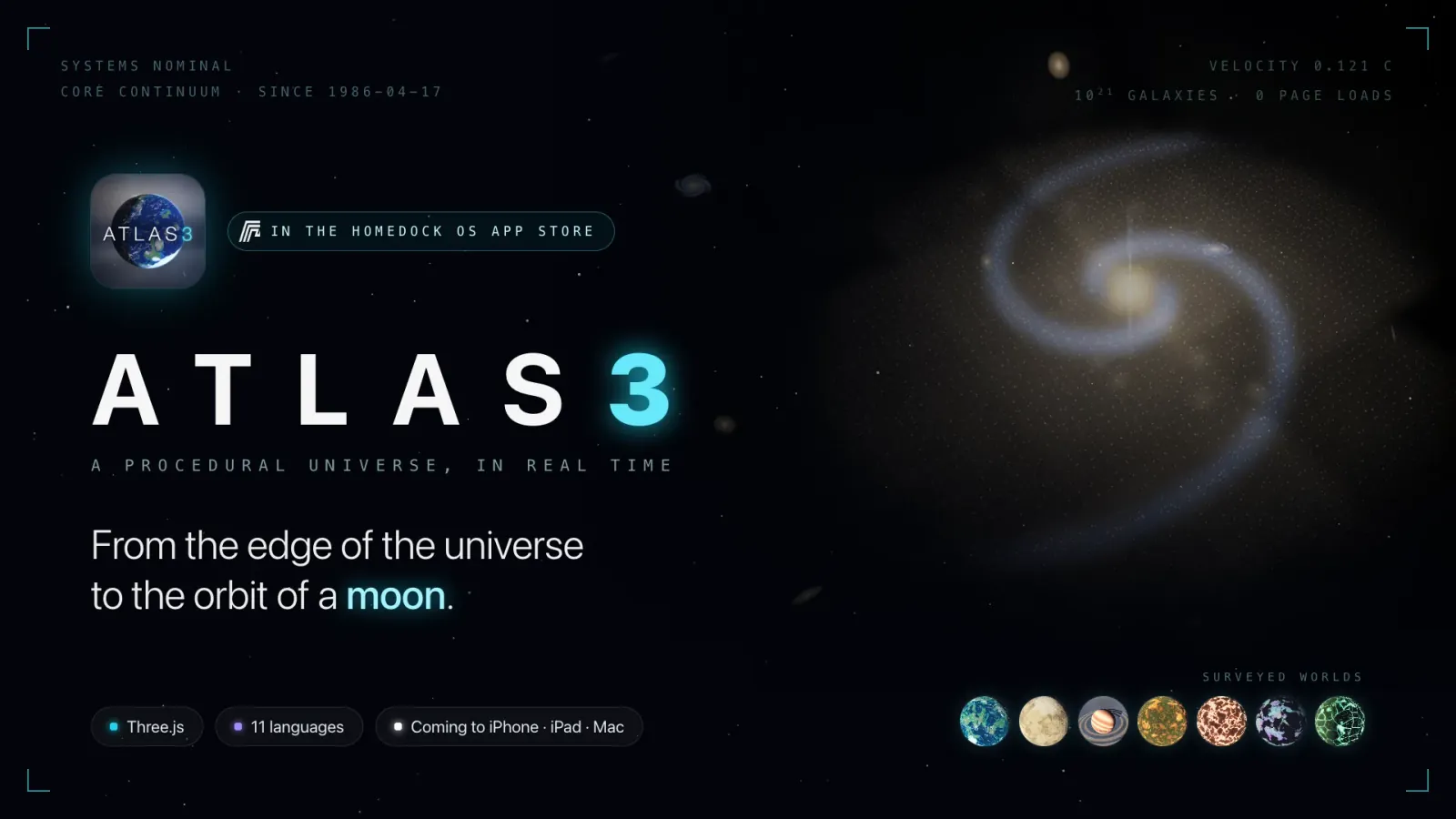
Until now you explored it page by page: a galaxy page, a system page, a planet page. ATLAS3 throws all of that away. The Atlas has been rebuilt from scratch as one single, continuous 3D universe in Three.js, where you fly from the edge of the universe to the orbit of a moon without a single page load.
It was supposed to ship in August. It’s mid October. HomeDock OS 2.6 got in the way, and the extra weeks went into polishing. ATLAS3 (3.0.0) landed on October 15, and today 3.0.1 follows it with eleven languages, a new soundtrack and the first piece of something bigger: The Atlas is coming to iPhone, iPad and Mac.
One Universe, Zero Page Loads
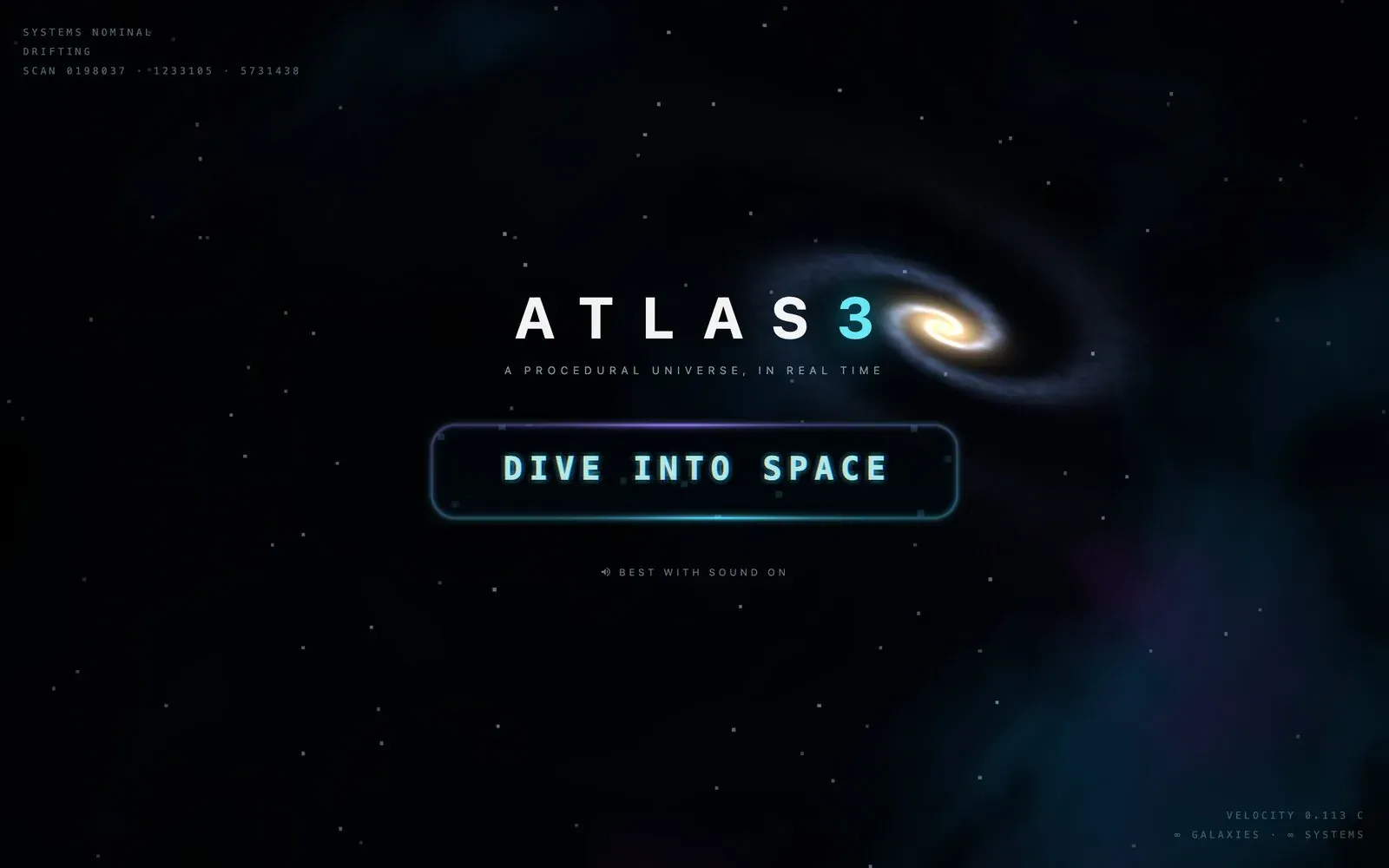
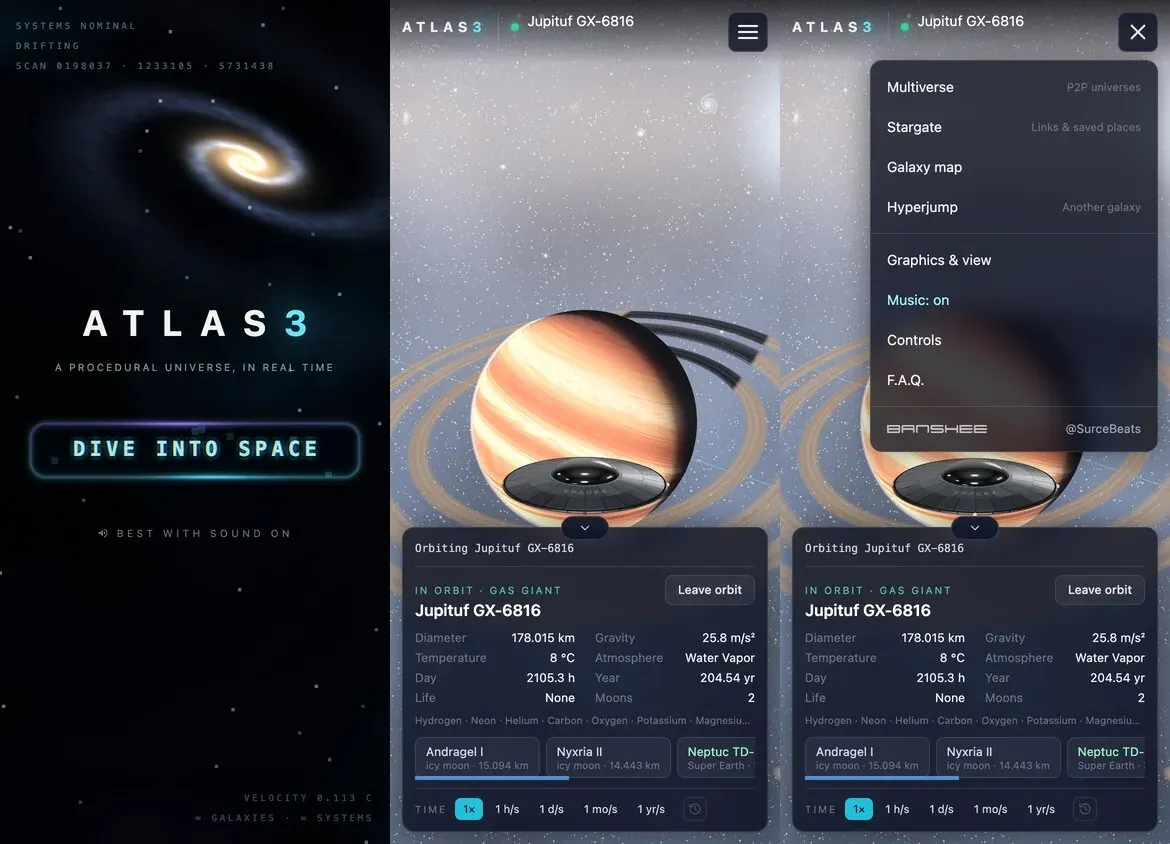
The first thing you see is the new front door: “Dive into the void”. A nebula, a distant galaxy, stars streaming past and the ship’s instruments, along with the universe’s primordial seed, its SHA-256, the exact moment of its Big Bang and its age ticking live. Press the button and you dive straight into hyperspace.
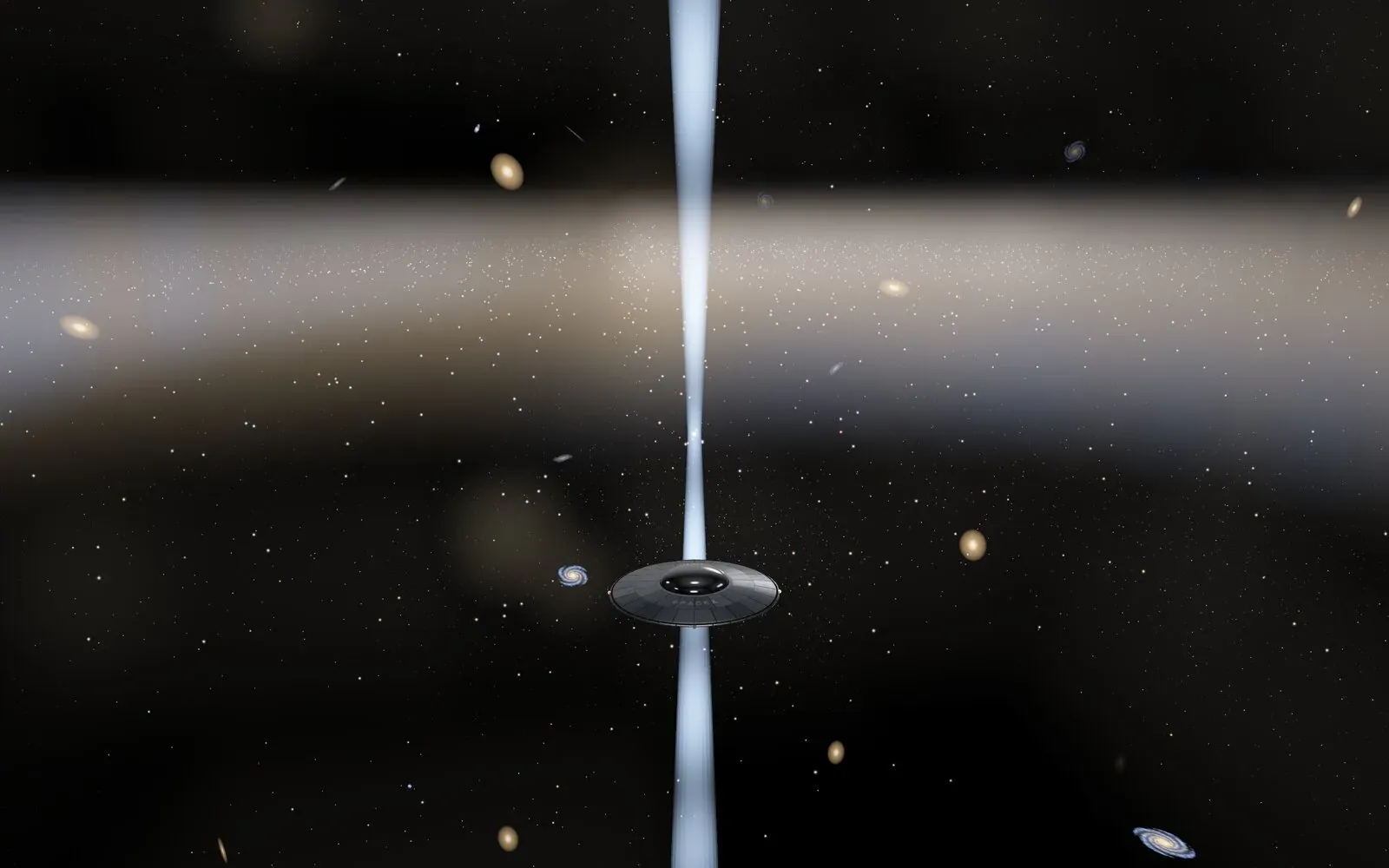
From there, everything is one space. Under the hood there’s a new rendering engine with a floating origin, so nothing jitters whether you’re looking at a galaxy from outside or skimming a planet’s surface, plus an HDR deep sky with tonemapping and eye adaptation. You fly a ship (a classic saucer, or the Interceptor, a twin-engine delta wing with “PLD” on its wings in honour of PLD Space), and every old link to a galaxy, system or planet now lands you in the right place inside the explorer.
Galaxies You Can Fly Into
Spiral, elliptical and dwarf galaxies, with bulges, bars, arms, globular and open clusters, black holes that bend the light around them, pulsars and quasars. From afar a galaxy is a soft glow. Fly in and it resolves into billions of individual stars, and every single one of them is a real system you can pick and fly to. The level of detail is computed in a Web Worker, so the view stays smooth while stars stream in around you.
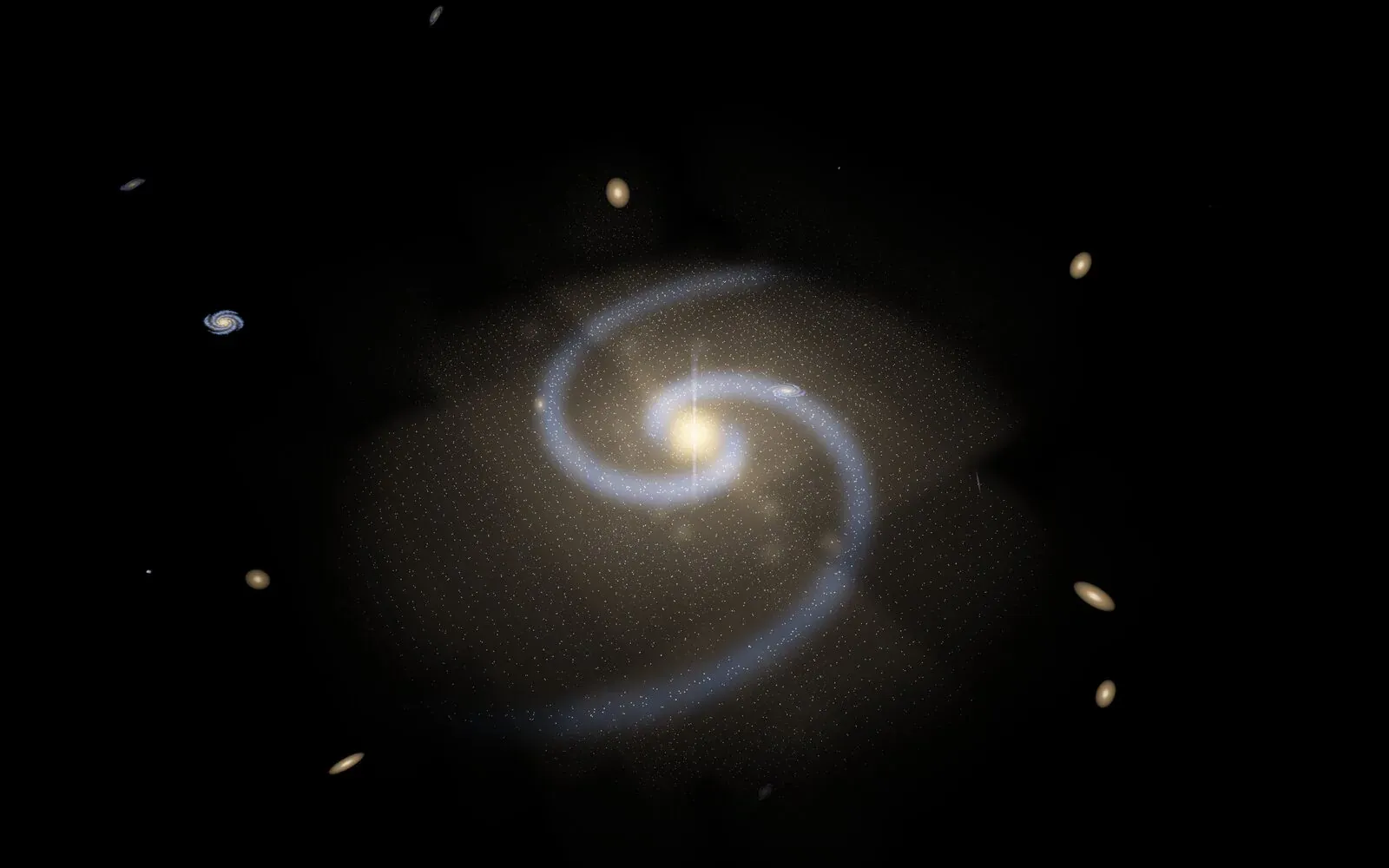
Galaxies now live in one continuous cube. Your neighbours hang in the sky around you, stream in as you move, and you can fly to them directly. Back out far enough and the new “To the universe” view shows the cells of the cube around your galaxy.
Star Systems in Real Time
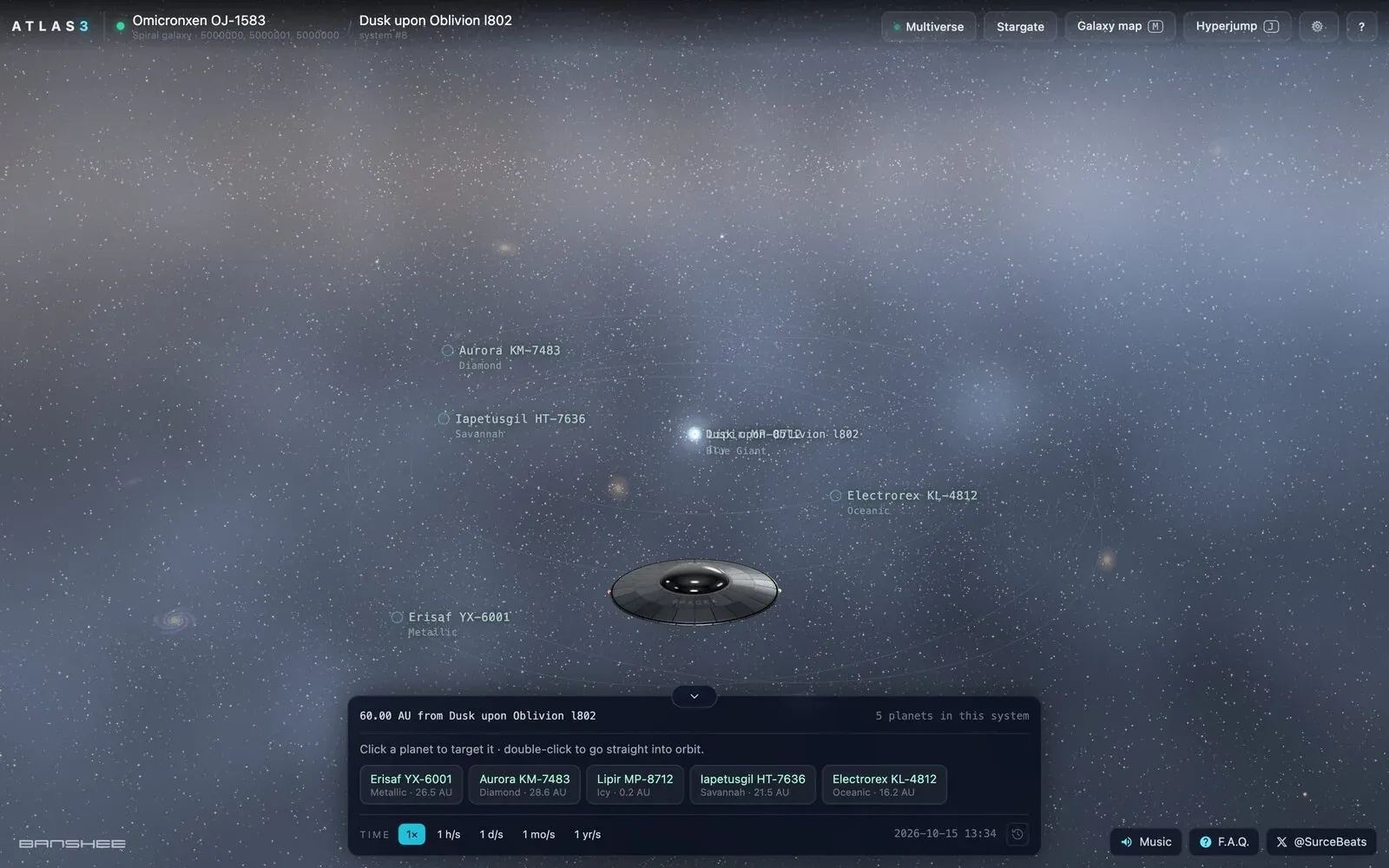
Single and multiple stars, planets on their real orbits, moving in real time, moons with orbits of their own, and eclipses where a moon slips into the planet’s shadow, reddened by its atmosphere. Moons can be visited too.
Time runs at its true pace by default. Speed it up to an hour, a day, a month or a whole year per second to watch orbits go by, and one click brings you back to the present.
26 Planet Types, Each One Drawn From Its Own Data
This is where most of the work went. Every one of the 26 planet types has a new, realistic renderer, and each planet draws its own structure from its seed, so no two planets of the same type share a shape. What you see comes from the planet’s data: its type, temperature, atmosphere, composition and life.
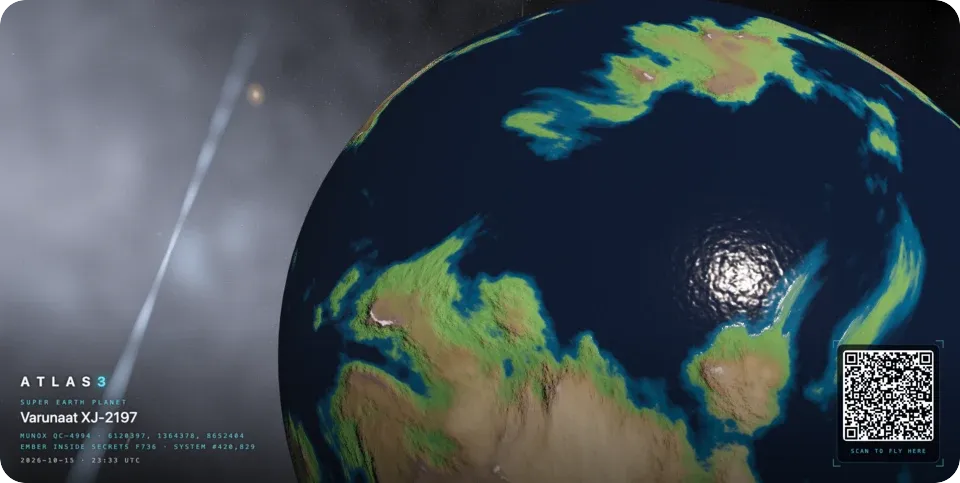
- • Earth-like worlds get continents, mountain belts, climate zones, vegetation, polar caps sized by the planet’s real temperature, clouds that cast shadows, glints on the ocean and city lights on the night side.
- • Gas and ice giants have bands that shear at their own speed, storms, Saturn-like polar hexagons, Neptune-like dark spots and rings with gaps that cast and catch shadows.
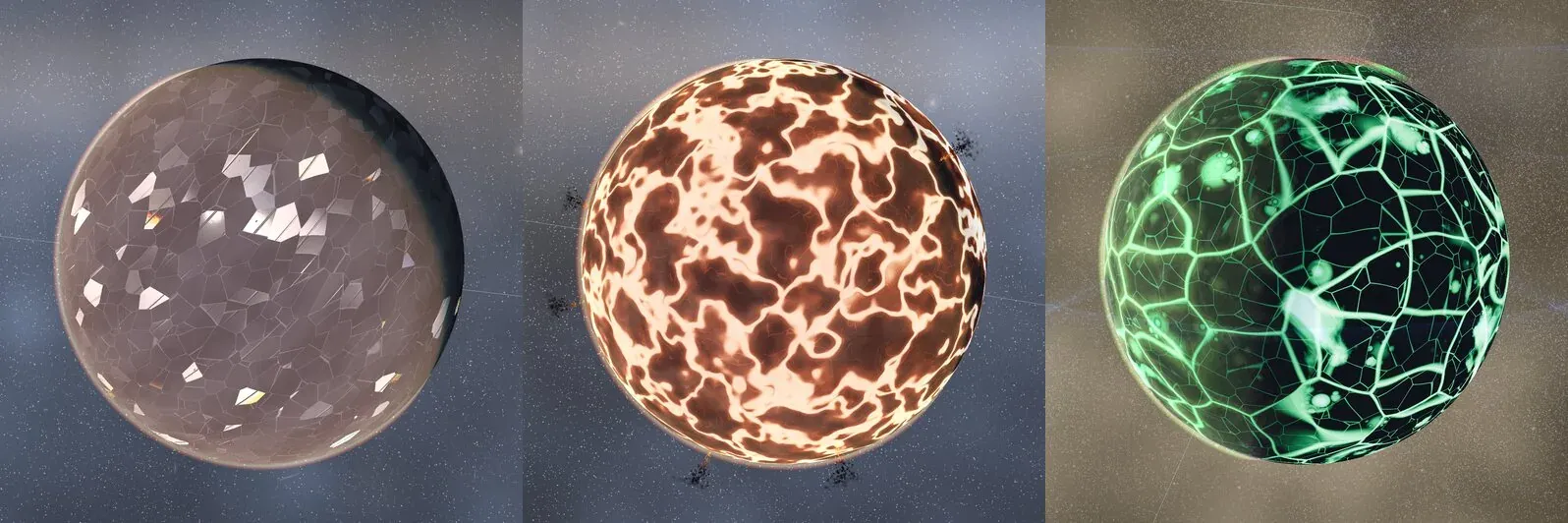
- • Molten worlds are now three different things: a cracked crust over glowing rock, a magma ocean with drifting rafts, and a mantle torn open to white-hot chasms.
- • Diamond planets refract light for real, with dispersion and internal reflections. Crystalline, metallic and radioactive worlds each have their own look, down to Cherenkov-blue cores.
- • Atmospheres scatter light like real ones do, with glowing limbs and reddened sunsets along the terminator.
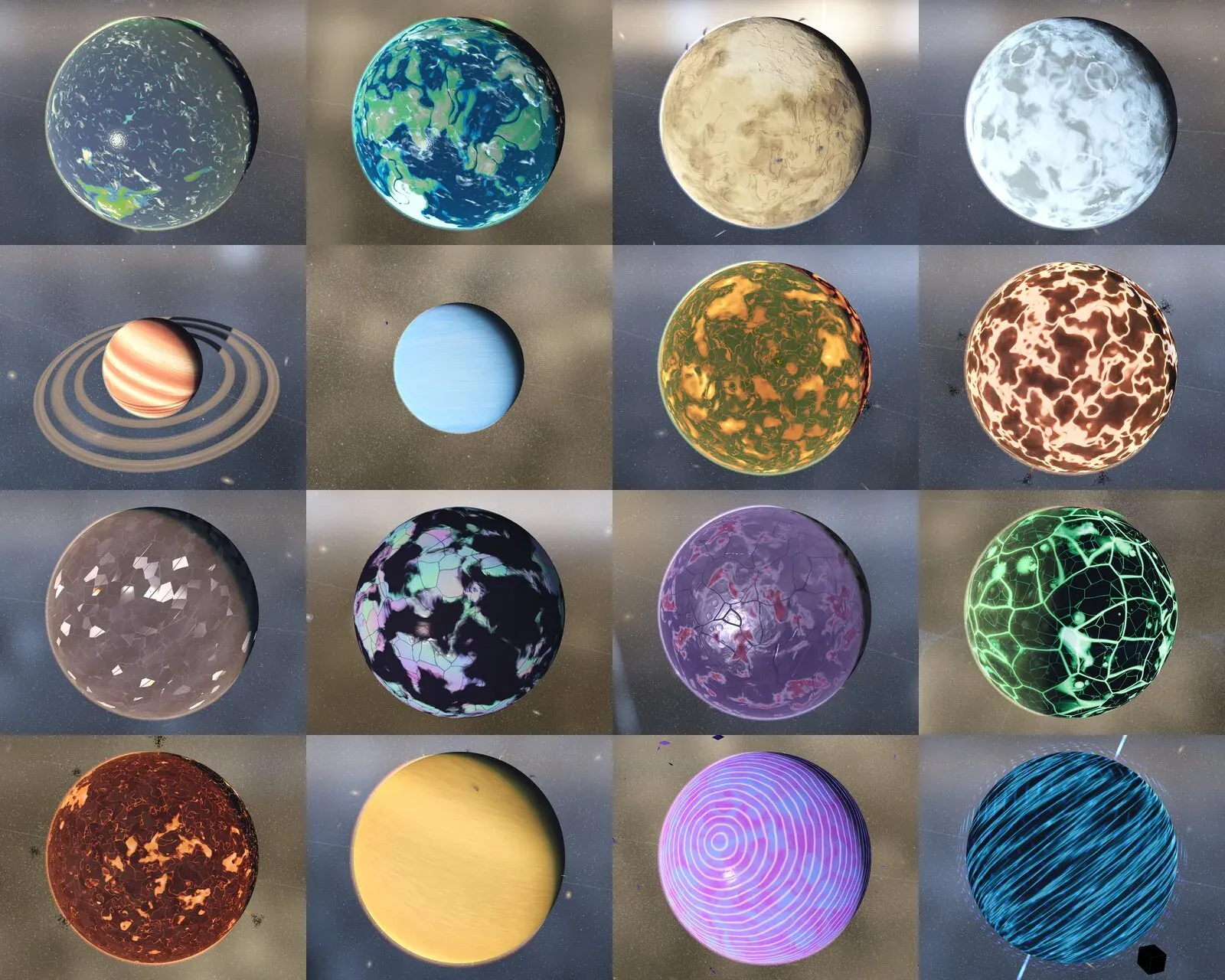
Life and phenomena show from orbit as well. Intelligent life leaves satellite constellations, orbital stations and city lights, robotic civilizations surround their world with hundreds of machines and an orbital ring, silicon-based life spreads glowing veins across the ground, and conscious gas drifts and pulses in luminous clouds. Then there are volcanic plumes, auroras, radiation belts, polar jets and, somewhere, a monolith.
And then there’s “Have I just found God?”, the rarest thing in the universe, completely redesigned for ATLAS3. We’re not going to show it to you. You’ll have to find it yourself.
Hyperjumps, Stargates and the Multiverse
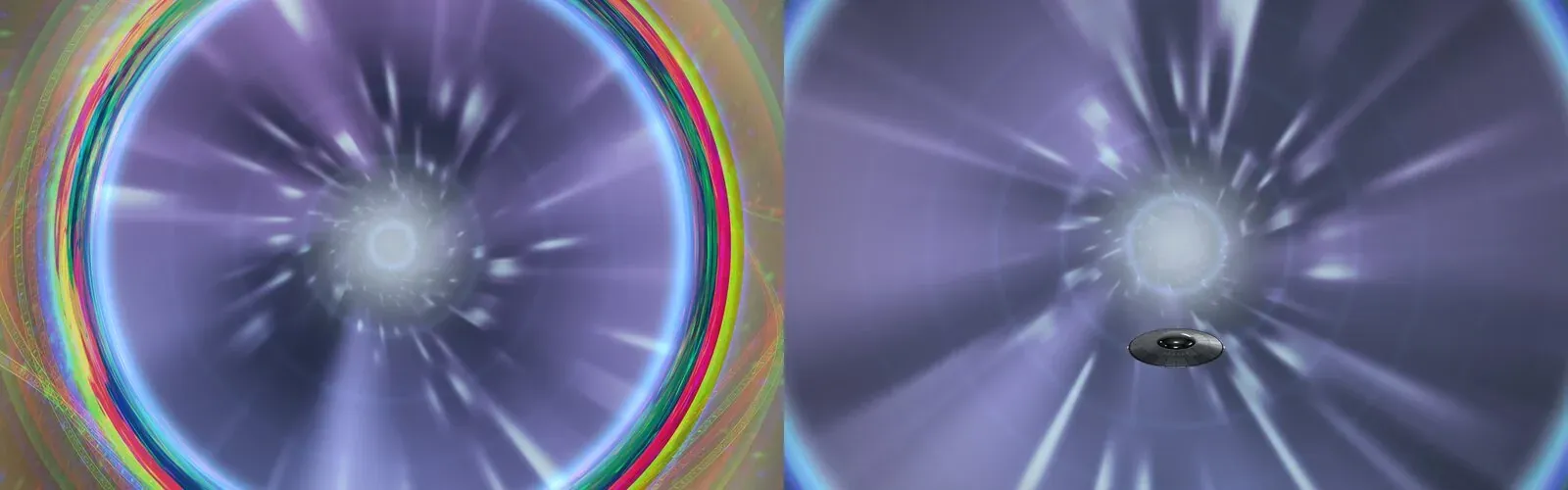
Jumping to another galaxy is now a show of its own. The drive charges, a wormhole opens and bends everything on screen around its mouth, your ship rides a hyperspace tunnel while the new galaxy loads, and a second mouth opens at the destination. Jumps to neighbours you can see in the sky are flown for real.
- • Stargates share a link to the galaxy, system or planet where your ship is, and saved places let you keep, rename and fly back to any of them from anywhere.
- • The multiverse is still peer-to-peer: universes discovered through other Atlas instances around the world can be visited from inside the explorer, with the crossing played as a jump.
- • Photos: press P and you get a picture of what’s on screen without the HUD, stamped with where it was taken and a QR code with the Stargate link to fly there. On a phone it goes straight to the share sheet.
- • Sound: a soundtrack of its own and quiet, synthesized ship sounds for flights, arrivals, orbits and jumps.
How Big Is The Atlas?
The shared universe everyone explores is called the Core Continuum, and it was born on April 17, 1986. It’s the same for everyone, which is why a Stargate link works on any Atlas instance in the world. And it is very, very big:
- • Galaxies: up to 1 sextillion (10²¹), one at every point of a cube 10 million units on each side.
- • Star systems: about 50 nonillion (5 × 10³¹) once the universe is fully evolved. A single large elliptical galaxy holds more systems than the Milky Way has stars.
- • Planets: one to six per system, about 300 nonillion (3 × 10³²) in all.
- • Stored worlds: zero. One seed, and the mathematics does the rest.
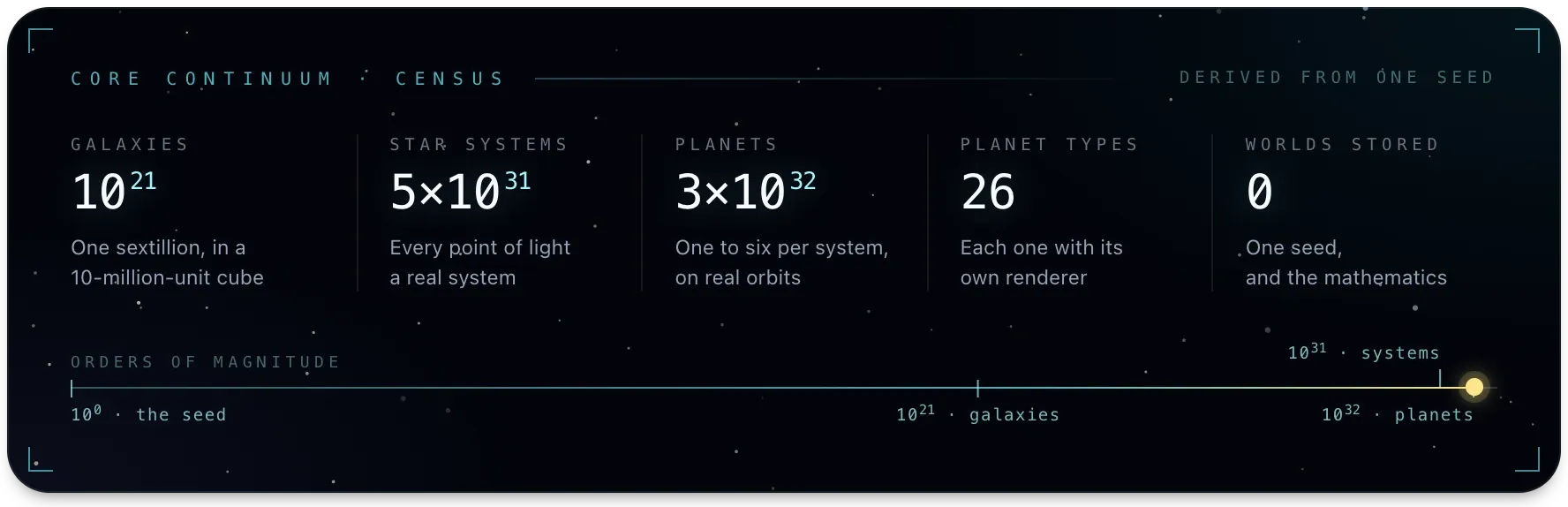
To put that in perspective: if you visited a different planet every second, it would take some 95 quintillion years to see just 0.001% of them. With all of humanity helping, it would still take 12 billion years. Storing just one byte per planet would take some 300 quintillion 1 TB hard drives, a stack about 630 light years high, which is exactly why The Atlas stores nothing at all.
What’s New Today in 3.0.1
ATLAS3 has been out for four days, and 3.0.1 is already here:
- • The Atlas now speaks 11 languages: English, German, Spanish, French, Italian, Japanese, Korean, Brazilian Portuguese, Russian, Ukrainian and Simplified Chinese. Every panel, the front door, the onboarding and the F.A.Q. follow your browser’s language, and you can switch at any time from the menu.
- • Owners of the Core Continuum now show up on the web: places claimed in the Apple apps carry their owner’s name everywhere, with their seal, their note and a line reading “Property of … since …”. More on that below.
- • A new menu, with Photo, Hangar, Music, Sounds and Graphics as one row of buttons, and a new “Auto” graphics quality that’s now the default and works out the right level for your device on every visit.
- • A new soundtrack in four pieces, Origin, Air Born, Deep Dive and The Family, shuffled on every visit and flowing into each other.
- • The Singularity Void, shown as what it is: the universe before its Bit Bang. Instead of a lone black hole, the primordial 4D torus turns at its heart inside a lattice of cubes, with a faint copy of itself in every cell around it, in superposition. It’s the same torus that opens the creation sequence of a new universe, frozen before time, as described in the Primordial 4D Torus paper.
The whole explorer also works on phones and tablets, with touch controls, a collapsible console and drop-down panels that always fit the screen.
The Atlas Is Coming to iPhone, iPad and Mac
This is the part we’ve been waiting to tell you about. The Atlas has been ported natively to Apple platforms, written in Swift and rendered with Metal, for iPhone, iPad and Mac. It’s the same universe, the same Core Continuum and the same Stargates, as one universal app: buy it once and it’s yours on all three.
And it brings something the web has never had: in the Apple apps you can claim your own place in the Core Continuum. A single planet, or a whole star system. You give it a name of your own, leave a note, and stamp it with your seal.
That name isn’t just for you. The Core Continuum is shared, so everyone who flies past your planet sees it, in the Apple apps and on the web alike, along with your seal, your note and the day it became yours. With 300 nonillion planets out there, there’s a world waiting for everyone.
The app is in review with Apple right now. We’ll let you know the moment it’s on the App Store. Until then, start scouting for the world you want to call yours.
Try It
The fastest way in is the
If you’d rather have your own copy of the universe, The Atlas is in the HomeDock OS App Store, one click away from your desktop:
Or run it with Docker anywhere, then open http://localhost:42424:
services:
  the-atlas:
    image: bansheetech/atlas:latest
    container_name: the-atlas
    ports:
      - "42424:42424"
    environment:
      - EXTERNAL_P2P_OPEN_PORT=42424
      - ENABLE_P2P=true
    volumes:
      - ./atlas_docker_volume:/app
    restart: always
On first start you choose between the shared Core Continuum or designing a multiverse of your own from any seed you like. The image is on
Find something beautiful out there? Take a photo with P and share it with us on
Thanks for being part of this journey ❤️
Related Links