GDPR Encryption Made Simple, only with HomeDock OS
Learn how Drop Zone helps freelancers and SMEs meet GDPR encryption requirements with military-grade AES-256-GCM. Simple compliance, unbreakable security
The Spanish Data Protection Agency (AEPD) published a stark warning in their November 2025 encryption guide: 50% of data breach notifications they received in 2025 March alone were caused by unencrypted data exfiltration, lost devices, or improperly secured communications. For freelancers and SMEs handling client data, this isn’t just a statistic, it’s… A wake-up call.
If you’re a freelancer, consultant, or run a small business in Europe, you’re legally required to protect personal data. But understanding the technical requirements of GDPR and implementing them can feel overwhelming. That’s exactly why we built Drop Zone into HomeDock OS, to make military-grade encryption accessible to everyone.
The European Encryption Landscape: What the Law Actually Requires
Europe has built a comprehensive regulatory framework that increasingly mandates data encryption. From GDPR’s foundational requirements to newer directives targeting specific sectors, the message is consistent: protecting personal data with strong encryption isn’t optional, it’s a legal obligation with serious penalties for non-compliance.
GDPR: Encryption as a Core Security Measure
The General Data Protection Regulation (GDPR) doesn’t just suggest encryption, it explicitly recommends it. Recital 83 states clearly:
“In order to maintain security and to prevent processing in infringement of this Regulation, the controller or processor should evaluate the risks inherent in the processing and implement measures to mitigate those risks, such as encryption.”
Article 32 further mandates that organizations implement “appropriate technical and organizational measures” to ensure data security, specifically mentioning:
- • Pseudonymization and encryption of personal data
- • The ability to ensure confidentiality, integrity, availability, and resilience of processing systems
- • Regular testing and evaluation of security measures
But GDPR isn’t alone. The European regulatory framework has expanded… Significantly, turning it most of the times into a headache for the non-technical freelancers or SMEs trying to stay compliant.
NIS2 Directive: Stricter Requirements for More Sectors
The NIS2 Directive, which took effect in October 2024, extends cybersecurity obligations to 18 critical sectors including digital services, manufacturing, and energy. It mandates:
- • Stronger encryption standards for data protection
- • Mandatory breach reporting obligations
- • Supply chain security measures
- • Administrative fines of up to €10 million or 2% of global annual turnover
If you provide services to companies in these sectors, your data handling practices directly affect their compliance.
DORA: Financial Sector Requirements
The Digital Operational Resilience Act (DORA), which entered into force on January 17, 2025, requires financial entities to maintain “high standards of availability, authenticity, integrity and confidentiality of data, whether at rest, in use or in transit.” This means encryption controls are mandatory for any entity working with financial data, including accountants, financial advisors, and fintech startups.
Cyber Resilience Act: Security by Design
The EU’s Cyber Resilience Act (CRA), which came into force in December 2024, requires manufacturers to build security from the design phase. Full enforcement begins by December 2027, but the direction is clear: encryption is no longer optional.
The Real-World Consequences of Not Encrypting Data
The AEPD’s encryption guide presents sobering case studies from actual data breaches. Here are some examples that illustrate what’s at stake:
Case 1: Lost Device, Exposed Children’s Data
A psychologist serving a primary school lost a laptop containing student records, names, photos, addresses, phone numbers, schedules, bus routes, and extracurricular activities. The unencrypted data was later found circulating on the dark web in child trafficking networks.
If the hard drive had been encrypted, the data would have been unreadable to anyone without the decryption key.
Case 2: Accidental Publication of Medical Records
A doctor at a family planning clinic stored procedure records in an unencrypted spreadsheet. After installing a file-sharing application, the table was accidentally shared publicly. Women who had undergone voluntary pregnancy terminations had their data exposed online, with devastating personal, social, and in some countries, legal consequences.
File-level encryption would have rendered the data useless even if accidentally shared.
Case 3: Cloud Backup Breach
A property management firm stored unencrypted backups with a third-party cloud service. Due to negligence or data theft by cloud provider staff, the data was leaked, revealing addresses, financial details, and living situations of elderly residents living alone. They became targets for scams and home invasions.
Pre-encryption before uploading to the cloud would have protected this data regardless of the cloud provider’s security failures.
How Drop Zone Solves the Encryption Problem
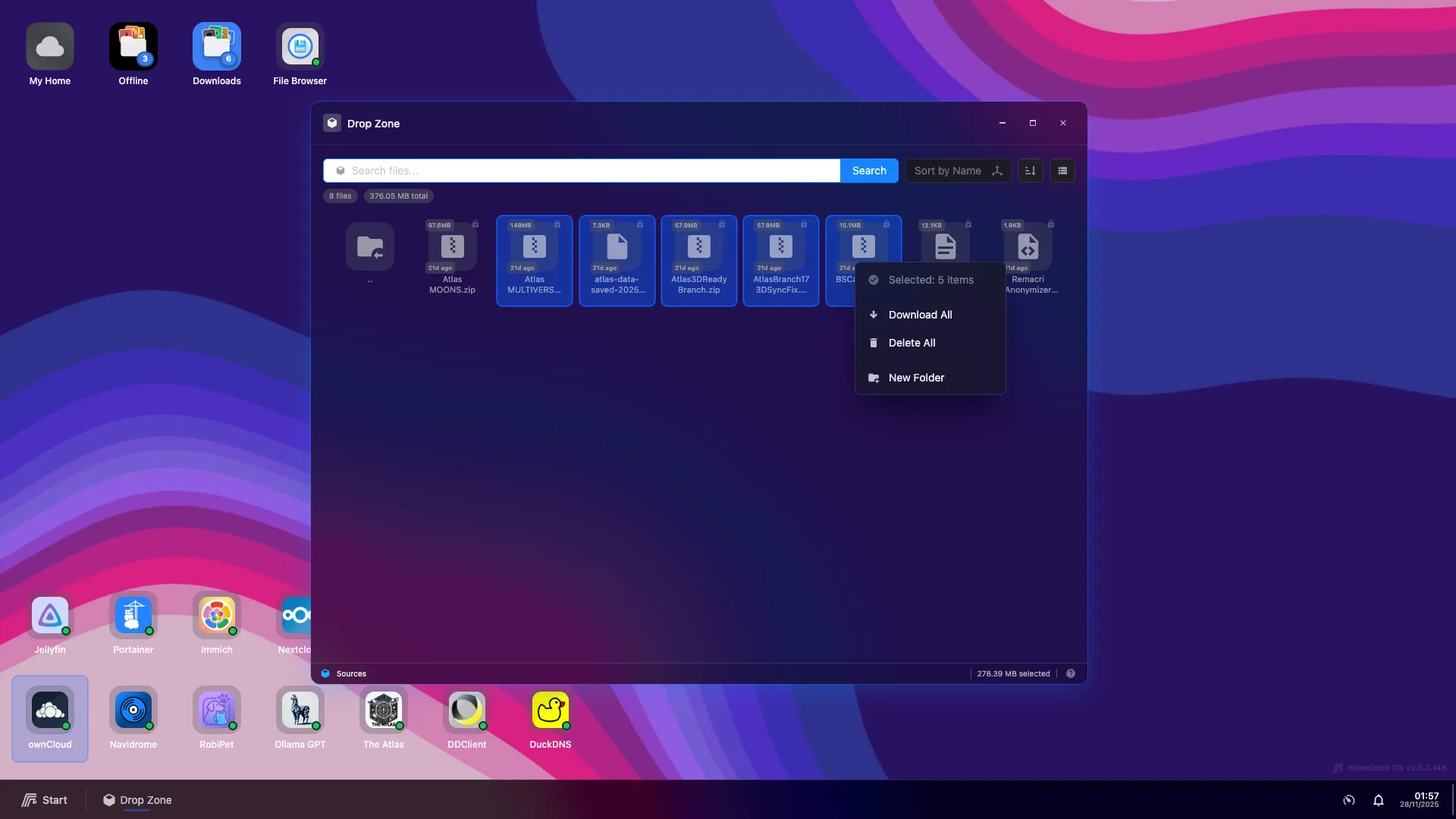
HomeDock OS includes Drop Zone, a secure vault built directly into your system. Just drop your files in, and they’re automatically protected with the same level of encryption used by banks and governments. No technical knowledge required, no complex setup, it just works.
The result? Your sensitive files become completely unreadable to anyone who doesn’t have your credentials, even if your device is lost, stolen, or hacked. It’s like having a bank vault on your laptop, except this one would take longer than the age of the universe to crack.
Want to know how we achieved this? Here’s a technical breakdown for those curious about what’s happening under the hood:
Military-Grade Encryption
Drop Zone uses AES-256 in GCM (Galois/Counter Mode), the same encryption standard used by governments and military organizations worldwide. This provides:
- • Authenticated encryption ensuring both confidentiality AND integrity
- • Protection against tampering (any modification is detected)
- • 256-bit key strength that is considered resistant to quantum computer attacks
How Strong is AES-256?
To put it in perspective: cracking a single Drop Zone AES-256 encrypted file through brute force would take approximately 3.67 × 10⁵⁷ years, that’s longer than the universe has existed, multiplied by trillions upon trillions. Even with theoretical quantum computers using Grover’s algorithm, AES-256 would still require computationally infeasible resources to break.
The AEPD recommends “at least AES-256 for data encryption and TLS 1.2 or higher for communications.” Drop Zone exceeds these requirements… By far.
Key Derivation: 1.2 Million Iterations
Drop Zone employs PBKDF2-HMAC-SHA256 with 1.2 million iterations, 12 times more than the legacy system’s 100,000 iterations. This means:
- • Brute-force password attacks are exponentially slower
- • Each user gets a unique 32-byte cryptographic salt
- • Rainbow table attacks are rendered ineffective
Per-User Encryption with Identity Binding
Every user’s encryption key is derived uniquely. Usernames are embedded as associated data during encryption, cryptographically binding files to their rightful owner. Even if someone copies another user’s configuration file, decryption will fail because the username verification won’t match.
Practical Compliance: What Drop Zone Enables
Here’s how Drop Zone maps to GDPR’s Article 32 requirements:
| GDPR Requirement | Drop Zone Storage |
|---|---|
| Encryption of personal data | AES-256-GCM encryption |
| Confidentiality | Per-user derived keys |
| Integrity | GCM authenticated encryption |
| Data binding | Username embedded in encryption |
| Resilience | Automatic legacy format migration |
For Freelancers and Consultants
If you’re a lawyer, accountant, therapist, or consultant handling client data, Drop Zone lets you:
- • Encrypt client files before storing them on any device
- • Secure backups without relying on third-party encryption
- • Share encrypted files knowing only authorized recipients can decrypt them
- • Demonstrate compliance with a documented encryption implementation
For Small and Medium Businesses
SMEs can use Drop Zone to:
- • Protect employee records in compliance with labor data regulations
- • Secure financial documents as required by DORA
- • Encrypt customer databases to mitigate breach impact
- • Meet supply chain security requirements for NIS2-covered clients
Beyond Encryption: A Complete Privacy Strategy
The AEPD emphasizes that encryption alone isn’t sufficient, it must be part of a broader privacy strategy. HomeDock OS delivers this by combining data minimization (you control exactly what’s stored), role-based access control (only authorized personnel see sensitive files), and complete audit trails (know who accessed what and when).
By running on your own hardware, you eliminate the “cloud provider as a risk factor” behind several AEPD case studies. Your encrypted data never leaves your control.
Unlike cloud solutions that promise security but retain access to your encryption keys, HomeDock OS ensures that you are the only one who can decrypt your files. No third-party can comply with a government subpoena for data they physically cannot access. That’s not just privacy, it’s mathematical certainty.
Getting Started with Drop Zone
Drop Zone is included by default in HomeDock OS. There’s no additional configuration required to start encrypting files. Simply:
- • Drop files into the Drop Zone folder
- • Files are automatically encrypted with your unique key
- • Access them normally, decryption happens transparently for authorized users
For organizations, centralized key management and backup key escrow options are available through the HomeDock OS dashboard.
The Bottom Line: Compliance Shouldn’t Be Complicated
European regulations like GDPR, NIS2, DORA, and the Cyber Resilience Act all point in the same direction: data encryption is no longer optional. The AEPD’s 2025 guide makes this crystal clear for Spanish freelancers and SMEs, but the same principles apply across all of Europe.
The consequences of non-compliance are severe:
- • Fines up to €20 million or 4% of global turnover under GDPR
- • Personal liability for executives under DORA
- • Reputational damage that can destroy client trust
- • Real harm to individuals whose data is exposed
Drop Zone eliminates the technical barrier. With AES-256-GCM encryption, 1.2 million iteration key derivation, per-user key isolation, and path encryption, it provides enterprise-grade protection that would take longer than the age of the universe to break, all without requiring a cybersecurity degree to implement.
Your clients trust you with their data. HomeDock OS helps you protect it.
HomeDock OS
EnterpriseSources and References
Image Gallery